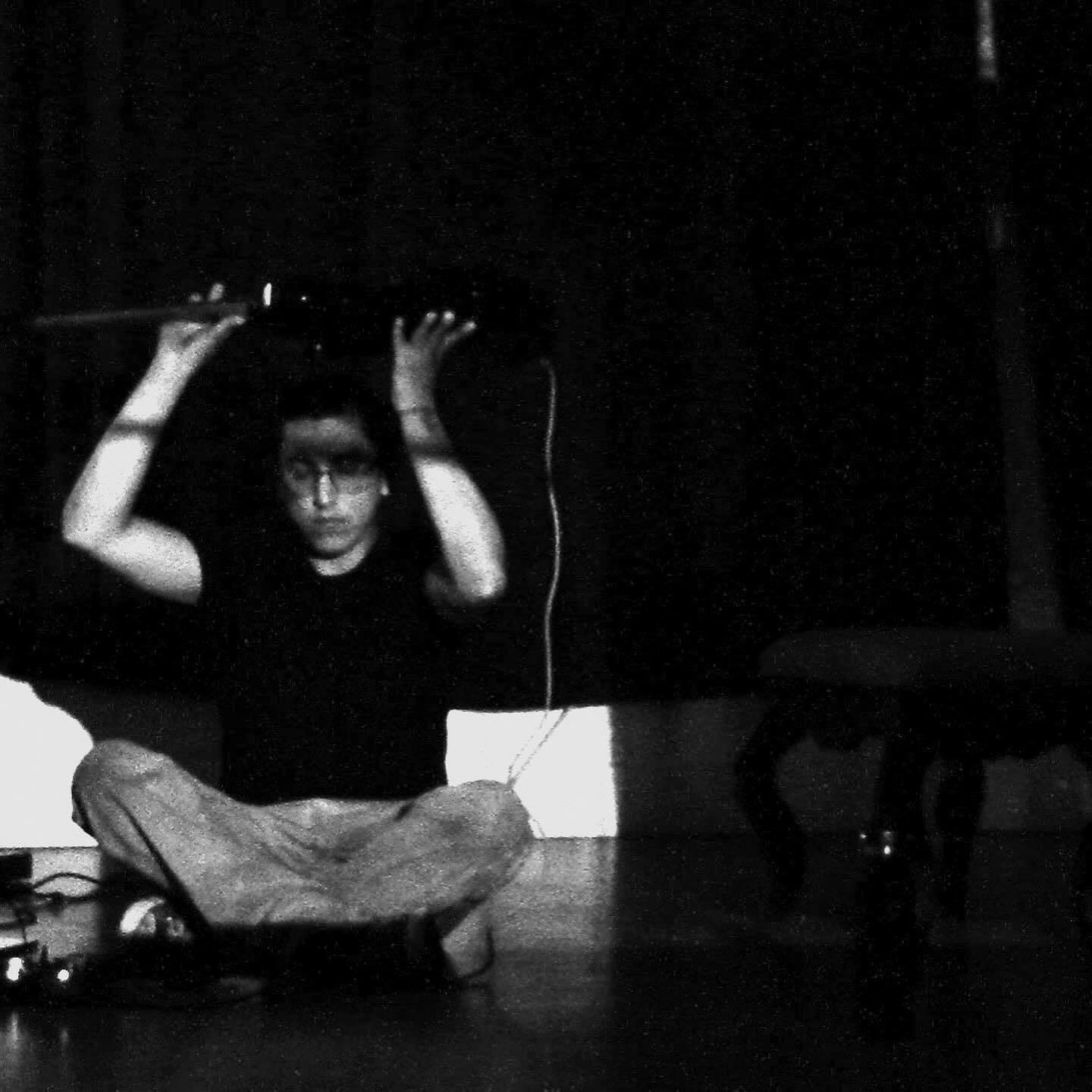
I’m pleased to feature Eric Michael Acosta on the blog where he has been serving as a consistent curator/collaborator/participant in the ongoing Unpoetry event series. He’s hosted over a hundred events since the first unpoetry at Underbelly in Pioneer Square in 2022.
Seattle Noise: Can you describe your background and what led you into creating Unpoetry? You moved to Seattle in 2018 from El Paso, Texas. How did moving here lead you into creating Unpoetry?
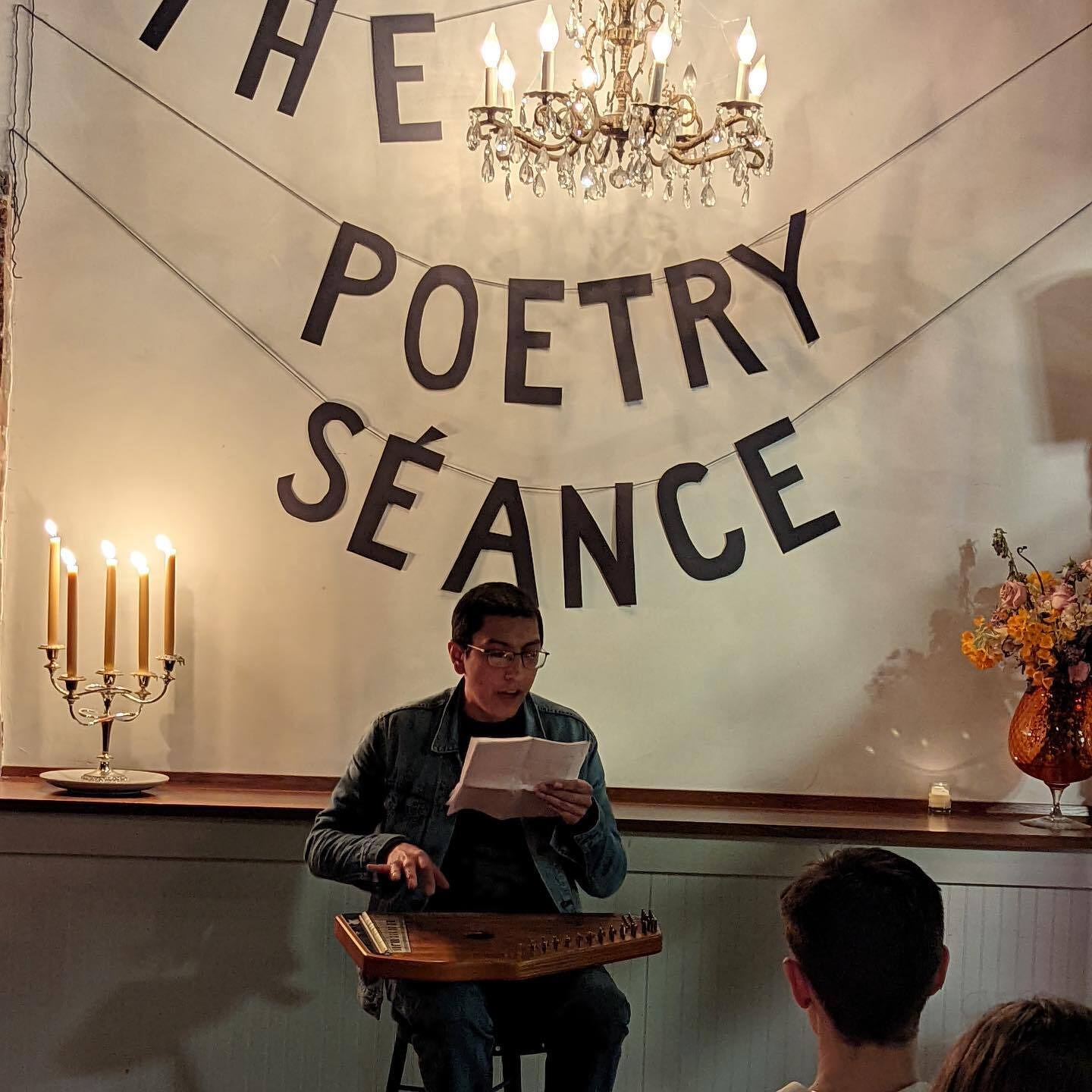
Eric M. Acosta: I moved up here to get my MFA in Poetics from University of Washington Bothell. Before I lived in Seattle I wasn’t nearly as driven. I was drinking and I was in crust bands, and I wasn’t going anywhere. It was frustrating. I was pretty lost. I got sober during the pandemic, and this kind of blew my mind open. That was also the first year I ever had therapy. Sobriety, and healing, the loads of extra time to find what I liked to do—these are what drove me to, and made me interested in experimental music, and really showed me a part of myself I had known was there and never understood how to engage. Post-pandemic I started being invited to do poetry at a few curated readings. I did sound and poems at Emily J. Mundy’s Poetry Seance. I was going to noise/experimental shows. Everything was kind of new. It made me excited to discover who I was as a performer. And that excitement led to Unpoetry.
Seattle Noise: Giving up on alcohol often gives people the space to create. I’m reminded of Taylor Troesh writing about how quitting alcohol provided him “with plenty of ‘boring’ hours.” to write. Did you experience something similar?
Eric M. Acosta: Sobriety has given me a healthier relationship to myself, which has allowed me to be there for other people. Unpoetry became a community on accident. Over the years it has become something more than an event for just me, and I wouldn’t have the tools to deal with these complex relationships and changes if it wasn’t for my sobriety. I also wouldn’t have the actual time. I was binge drinking myself to sleep at least 4 or 5 nights a week, that took an immense amount of bandwidth—and now I have all that time for me—to actually live in service of myself and others, and not in service of avoidance.
Seattle Noise: Despite the name, much of what happens at an Unpoetry event may or may not include poetry reading. Do you curate the lineups with any sort of intent or do they remain fairly open ended?
Eric M. Acosta: Unpoetry has shifted in my head from stage time to event series to a response. Unpoetry has become a series of questions—what art is held where, for what reason, and how is this manifested. Unpoetry focuses on art for art’s sake. Holding the space open just to hold the space open, creates a fertile energy for art to grow from.
At first there was no intent, sometimes there were themed shows, but through the years it has become very intentional. I try to invite as many genres, career levels and scenes as I can. I am increasingly intentional about creating lineups that are inclusive—highlighting women, and inviting BIPOC, queer and trans artists. The idea is always to experiment, and to aim towards newness, and that’s all about who I invite to perform.
Seattle Noise: Let’s talk about place. You’ve shifted locations but always the core format remains the same. At the same time the setting of place can have an effect on presentation and experience. Does something change for the performers or the audience when you host the event in different spaces?
Eric M. Acosta: Every event is first in collaboration with the space. Venue/spaces have their own vibe, and their own levels of energy that they can hold, subdue or amplify. Each space and venue also has a history and a place in Seattle’s creative lineage that can’t be uncoupled from the event. I think about this a lot when I start creating lineups—how do you add to the space, or circumvent it, and how do you work with its asynchronicities to form something alive?
In tandem with these factors, each venue has its own technical capabilities, which changes what art form I can feature. Venues bring their own community that comes with its own expectations of what is held in their space—some places don’t like loud and noisy, others expect poetry only, some are more for performance art, a venue can be more BIPOC focused, or sometimes we’re in someone’s house—all of these are things I’m thinking about as I make a lineup, and they are all factors that I’m dealing with as a host, and this is energy that is transferred to performer and audience and event.
Seattle Noise: How have some of the big milestones affected the nature of Unpoetry? Some to note:
Eric M. Acosta: Unpoetry at the Frye (in 2024, 2025, and 2026) has affected the nature of Unpoetry more than anything because it’s such a big production. This event asks local artists to create new work based on the museum’s current exhibits—together we weave movement, sound, and poetry into an artist-led tour through the new gallery spaces.
It’s the first time I’ve worked with a large institution, and the first time I’ve worked with someone to create Unpoetry. I work closely with the Frye Publics Program Manager, which has evolved into a trusting working relationship. While she leaves lineups up to me, we have created a space where both of us feel comfortable sharing our ideas and wants.
Unpoetry at the Frye has evolved into a big show – planning for each event takes 3 months—I meet with the Frye Public Programs Manager, I reach out to artists, we have at least 2-3 in-person meetings where we think about and craft the show together. All the artists work in collaboration with each other. In addition we have tech meetings, and dress rehearsals—and because of all the moving parts, it’s shown me that I have the creative and administrative capacity for creating larger and longer form shows, and has also given me processes for bringing these ideas into the real world. It makes plans and ideas for all Unpoetry bigger.
The Jack Straw Artist Support Program in 2025 was a big milestone in terms of Unpoetry accessing parts of the legitimate Seattle literary and sound scene. It is a good thing to have on the resume, and working with Levi is valuable and fun. I brought as many of my friends in as I could. It was a big stage, a big spotlight, and I definitely wanted to use that to other people’s advantage.
Another big milestone was receiving a 4Culture Projects Grant last year. I received $10,500 for Unpoetry. I used $8,000 for artist honorariums. 4Culture’s endorsement puts Unpoetry into the broader Seattle art event ecosystem, and increases opportunities to receive more funding. Being recognized by such an important local institution gives me hope for what Unpoetry could be.
The Frye, Jack Straw and the 4Culture Grant primarily lends legitimacy to Unpoetry, which I think can open doors and bring us into more spaces. And going back to your question about intention, having large spotlights, increases my attention to the responsibility I have to be intentional with the lineups. It’s really important to think about who I’m inviting, and why.
With these opportunities, and the visibility they provide, it’s important to think about what “inclusion” means, and apply the tenets of experimental art to lineup creation. Embracing the experimental is not just about engaging with and showcasing out-there art forms, but inviting people in who are excluded. It’s so important to focus on new artists, experimental forms, and to highlight queer, trans and BIPOC communities. And within this drive for actual inclusion, it’s equally important to highlight older or late-in-career artists, and also to give time to the people who continually make space for others. The more opportunities Unpoetry gets, the more responsibility I feel I have to empower as many artists as possible.
Seattle Noise: You also host __ Poetry Lab where the event is structured around a single artist. How do those events differ from Unpoetry?
Eric M. Acosta: __Poetry Lab focuses on one artist, giving them 45-60 minutes of stage time, plus a live interview during the show. The featured artist is welcome to invite others they want to work with, but it is their show, their spotlight and community. The format of __Poetry Lab is a little fluid, but always contains the long focused set time and the interview – in this way it’s more predictable than Unpoetry. __Poetry Lab is a space that is not often created for local artists—that focus, that time—is rare. __Poetry Lab is offering something new to artist and audience communities.
First, because it always comes up—Unpoetry is a curated series, and not an open mic. Unpoetry is a standard type of multidisciplinary showcase. Unpoetry is whatever I want it to be, whatever it has to be, and it comes about in whatever form it must. Unpoetry is about including lots of people, it’s about everyone, and because of this, it can be anything. Unpoetry is about invitation. There will be a wide range of performers at Unpoetry—even if they are all poets, or all sound – there will be many different types of that genre, and people you wouldn’t expect to be there.
In my mind they are the same, but the __Poetry Lab name is supposed to give a signal to the audience that this will not be as everywhere all at once as Unpoetry.
Seattle Noise: How would you describe the distinctions between your different creative practices? What about when you are performing what distinguishes Bottle Meat from when you perform under your own name?
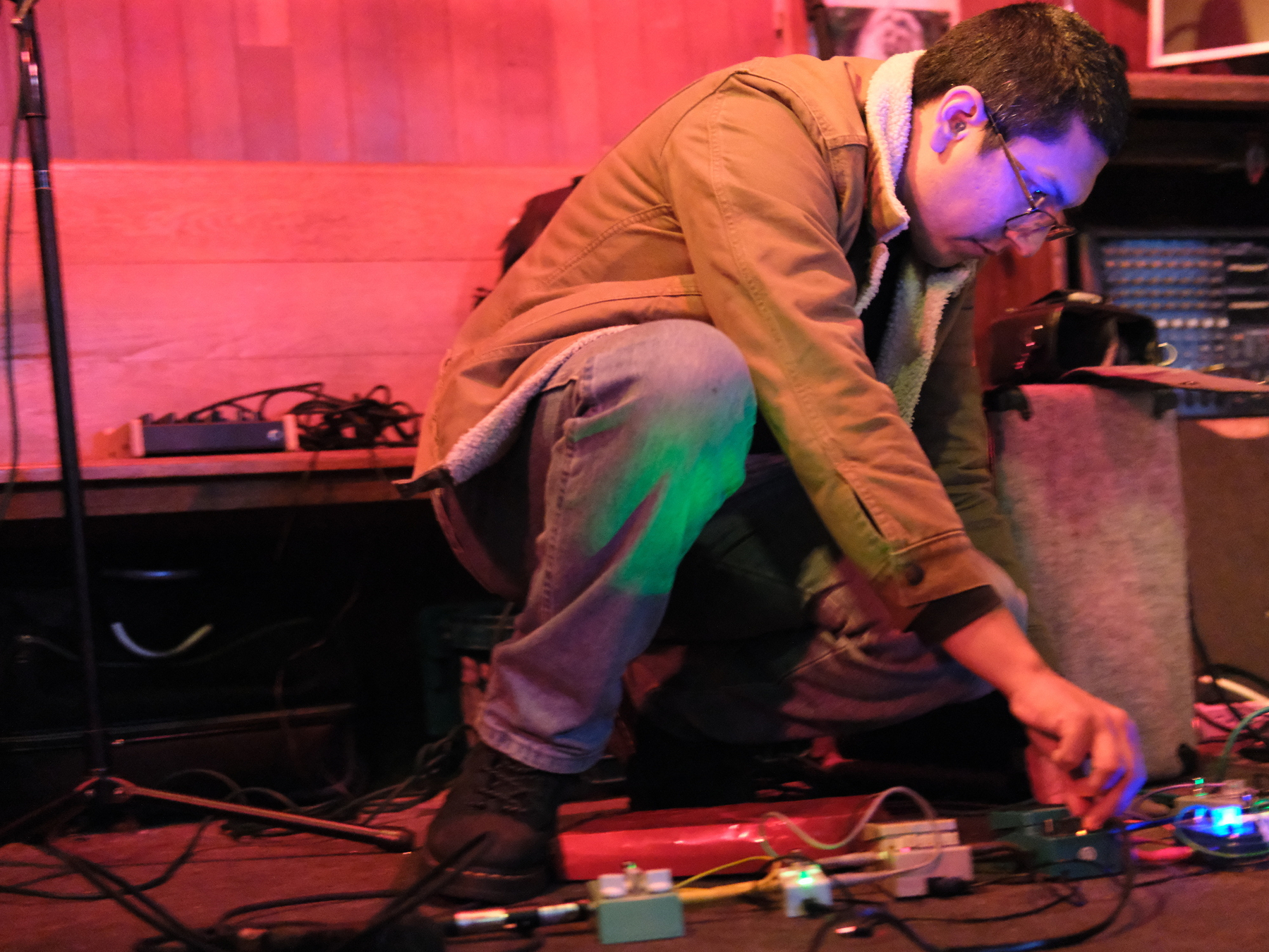
Eric M. Acosta: There used to be a bigger distinction between performing under Bottle Meat, and performing under my name, but now I mainly use Bottle Meat to mean that I might be super loud and screechy. Performing under Bottle Meat makes me feel comfortable that the audience knows what they’re getting into. Performing as Bottle Meat has become a way for me to do whatever I want. What I create as Bottle Meat in the experimental sound space was refined in the space I created with my performances within Unpoetry.
In noise/experimental scenes my actual name can operate the same way, but my name travels through poetry lineups, and recently dance and yoga, so it’s meant to signify something more streamlined, and possibly dictated by the format of the show or scene in which it appears.
Seattle Noise: You mentioned in one of your emails about the toxicity of nostalgia and I enjoy reading your perspective on it. I often think about how nostalgia is the death of art. Care to add anything more?
Eric M. Acosta: As someone who is making things now, the only hope I have is what is being made around me and in this time. I can’t escape the weight of history’s influence and coolness. Especially since I have so much access to whatever I want from whenever I want. But I’m an artist living and working now, and there are so many people working around me who are talented and interesting and fun to engage with. If I lose myself in the past, then that erases me and a lot of my friends and community members.
Seattle Noise: Unpoetry thrives on the community of artists, musicians, and writers. Who have been some of your fellow collaborators?
Eric M. Acosta: I love working with my friends, and using these collaborations to make new friendships—I love working with Anna and Levi Fuller, Unpoetry started me working together with Sully, joining forces with Al Jones for the Noumena fest, and Sophie Chin, Whitney Bashaw, Emma Mcveigh on Wayfinder—me and Tom Scully have a good jamming vibe—Hyperboy hyperboy hyperboy—Adam Levitt and Till the Teeth—I’ve gotten to work with the recently passed Carol Levin—I’ve loved working more with dancers recently – Gia, Symone, Tshedzom, Alia, Hannah. I guess there’s no favorite, and that’s not a political or social answer—I’ve gotten a long list of collaborations in not a long time. Unpoetry has put me on so many people’s radar, and it has connected me to many talented and capable artists.
Seattle Noise: What about your published work? Is there a relationship with your performances? Do you see it as an archive?
Eric M. Acosta: I think everything I do is an archive of my creative process. Does archive mean I’m dead? Like my time will pass and only the archive will matter? Maybe that’s the landscape artists live in now, and it’s also what we’ve always contended with. Possibly. It’s more a living document of my shifting mind–maps and maps of brain waves. I have almost all of my published poems in audio on either Unpoetry or Bottle Meat Bandcamp pages, and on video at my YouTube channel, a large chunk of stuff. I love the idea of my audience seeing my mind shift through time. And I like to look back at everything and think about the person I was, and the artist who made those decisions, that’s fascinating. Mainly I put out so much work because my process is tied to sharing–not to the response, but to actually displaying the work. For me something is not done until it has been displayed.
Seattle Noise: Do you have any goals for your own creative practice beyond organizing events?
I’m creating my first short film to debut at this year’s Drongo Fest. I’ll try and screen it again later in the year. I’m working on putting together the Unpoetry Zine for our paid members on Patreon,Ko-Fi, and Buymeacoffee. This will be a transcribed conversation between Dujie Tahat, Nanya Jhingran, Primrose Berglund and myself with photographs by Rodrigo Sanchez. I’m working with Run Your Mouth Press and Idle Hands Press to put out my chapbooks “Kona” and “Celestial Dentist” this year. I have ideas of creating a solo art exhibition/installation in the near future. I also have to figure out what other thing I’m going to send to the Unpoetry members at the end of the year.
Seattle Noise: Wrapping things up, what’s the best way for people to follow you and what should they be looking forward from you next?
Eric M. Acosta: Instagram (@bottle_meat) is the best for following everything about me and Unpoetry. I have all of my books available to read online at printcopiesavailable.com, you can sign up for my newsletter which is monthly Unpoetry info and a calendar of Seattle events at unpoetry.net. I also have a YouTube channel that I don’t think people pay attention to which has so much of Unpoetry on it. I know the video quality isn’t that great, but it’s very listenable. There’s also the Unpoetry Bandcamp. For this interview, I am releasing a new Bottle Meat live record.
Eric has published in print in 2023 underbelly from Carbonation Press and Motion Flesh from Chat Rooms Press.